The Pain Flexibility workbook

A workbook for living more fully with chronic pain.

Understand pain, practice nervous-system regulation, and take small, workable steps toward what matters to you.

Live More. Suffer Less.

Paperback · Coil-bound · Hardcover
Available now: Paperback. Coming soon: Coil-bound · Hardcover.

Pain is real. Small steps count.

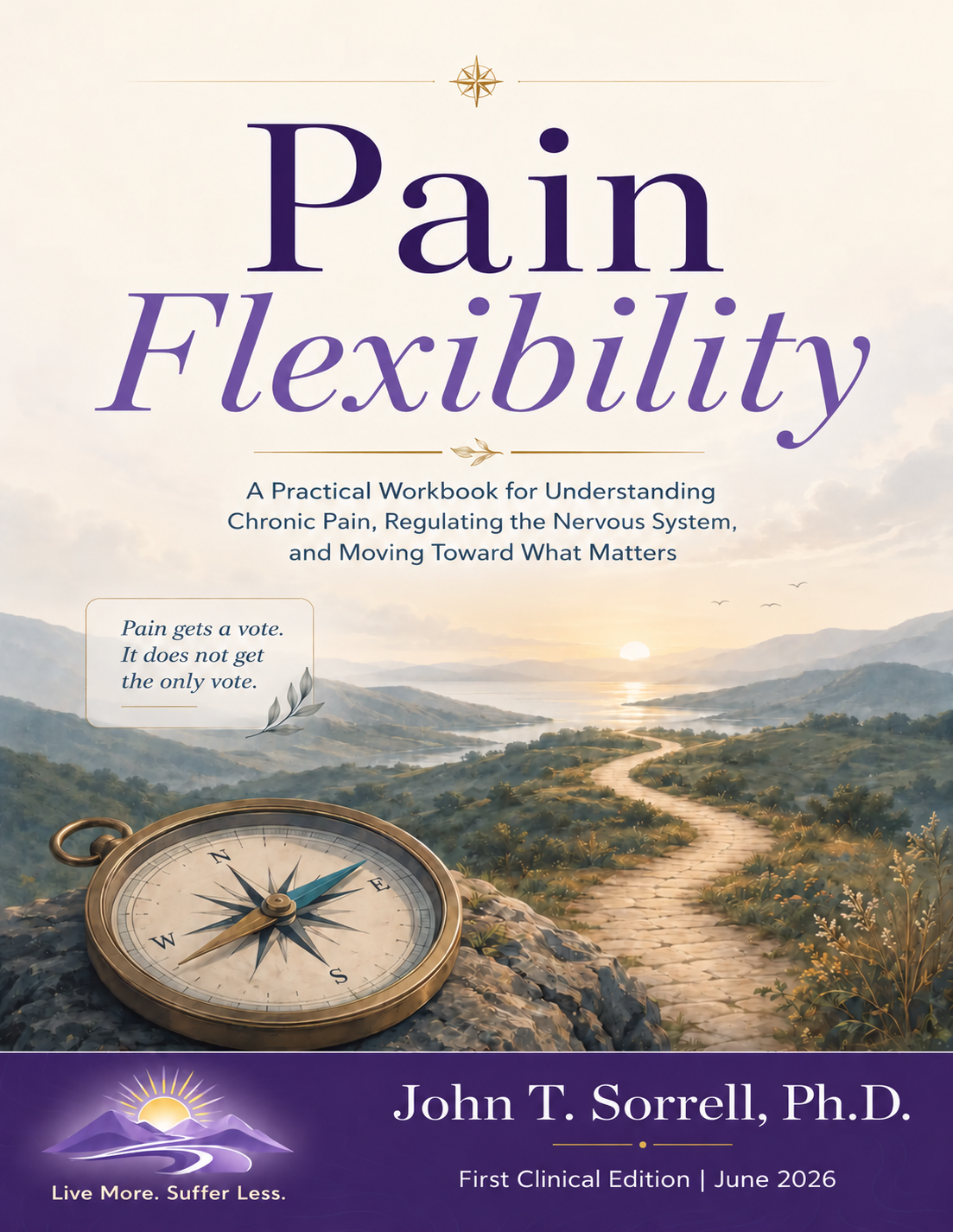
Cover of the Pain Flexibility practical workbook by John T. Sorrell PhD.
A practical workbook for understanding chronic pain, regulating the nervous system, and moving toward what matters.

A short film about pain flexibility

INSIDE

2 minutes, 9 seconds · Narrated with music · English captions

Understanding pain and protection

INSIDE offers one way to understand how overwhelming experiences can shape our responses—and opens a conversation about recovery.

Pain and threat both engage the nervous system’s protective responses. Pain can warn us of danger, but it can also persist without ongoing tissue damage. Stress, past experiences, and signals from within the body or the world around us can heighten these responses and contribute to ongoing pain. INSIDE explores how we protect ourselves and find safety and connection, offering another way to understand what can shape the experience of pain. Whatever its causes, your pain is real.

Press play to watch. Use the player controls to pause, adjust sound, or turn captions on and off. Open the video separately.

Film and music credits

INSIDE
Created by John T. Sorrell, Ph.D.
Narration: Vera · AI-generated voice

Music: 'A Kind Of Hope' by Scott Buckley — released under CC-BY 4.0. Track details.
Music excerpt edited, synchronized to film, volume-adjusted, and faded.

The CC-BY 4.0 license applies to the underlying music, not the film as a whole.

The Pain Flexibility workbook

Choose your workbook

Available now

Workbook editions

Choose your edition

Order an available edition below. Other formats will be added as they become ready.

Paperback

A familiar, flexible softcover book.

$34.95 USD

Buy paperback

Coil-bound

Opens flat for writing in the workbook.

Coming soon

Hardcover

A sturdy edition for repeated use.

Coming soon

Paperback: $34.95 USD. Shipping and applicable taxes are additional; review your total at Lulu checkout.

Purchase availability

Choose your edition above to view current pricing and delivery details and place your order.

Cover of the Pain Flexibility practical workbook by John T. Sorrell, Ph.D.
Core publication

Pain Flexibility workbook

A practical resource for understanding chronic pain, building coping skills, and taking meaningful steps forward.

1 print edition availableAvailable now
Read the free sample chapter

Pain isn’t the enemy.

Pain isn’t always wrong.

Pain also isn’t the boss.

The Pain Flexibility approach

More ways to respond. More room to live.

Pain can change your life. It doesn’t have to define it. Chronic pain can pull people between pushing too hard and withdrawing from life. Flexibility offers another path: respond to each moment with a wider set of physical, emotional, mental, and social skills.

01

Move gently

Build confidence through pacing, gradual activity, and a more flexible response to changing symptoms.

Try thisChoose one small, workable step—not the biggest step.
02

Change your thinking

Notice fear-based predictions, check the facts, and make room for a more accurate and compassionate response.

Try thisAsk: Is this dangerous, uncomfortable, or uncertain?
03

Regulate your nervous system

Practice skills that can lower the volume on stress activation and create more room to choose what happens next.

Try thisTry a slow, soft, comfortable breath—without forcing it.
04

Do what matters

Reconnect with meaningful roles and activities, then take realistic steps toward the life you want to build.

Try thisLet your values point to the next right-sized action.
05

Stay connected

Strengthen communication, ask for support effectively, and protect the relationships that pain can strain.

Try thisName one person you can include in your next step.
This is not about ignoring pain.

It is about building skills so pain has less power to make every decision for you.

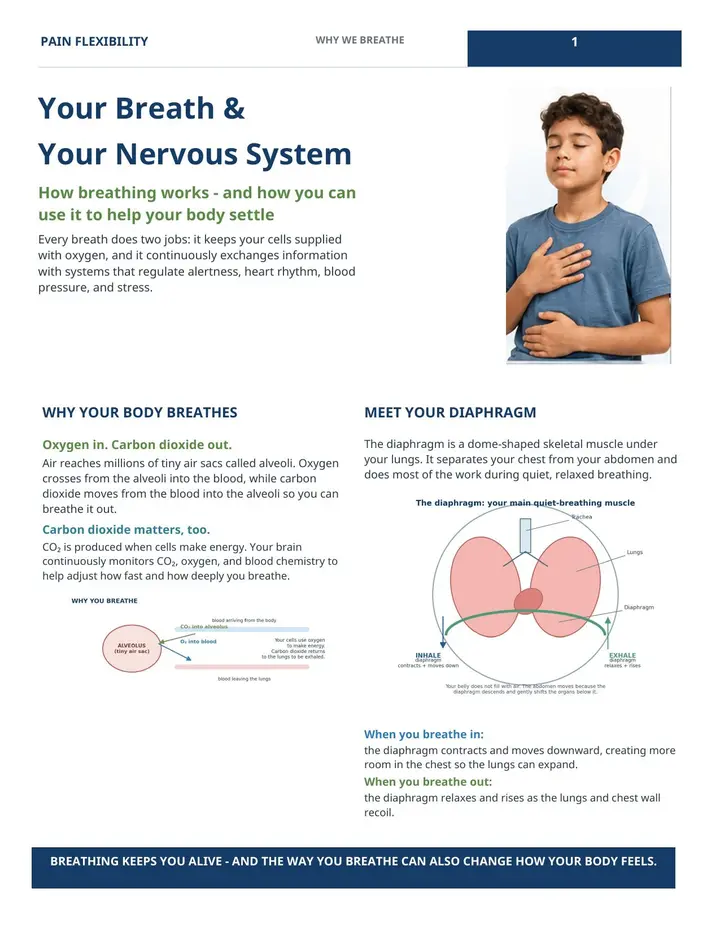
Cover of the Pain Flexibility sample chapter, Your Breath and Your Nervous System.4-page sample

Inside the workbook

A practical guide for living more fully with chronic pain

The Pain Flexibility workbook is a clear, step-by-step resource for understanding persistent pain and practicing skills that support adaptability and participation in everyday life.

  • Understand how pain, stress, thoughts, emotions, and behavior interact
  • Practice nervous-system regulation without chasing perfect relaxation
  • Use reflection prompts and small-step planning
  • Reconnect action with values, support, and quality of life

Read “Your Breath & Your Nervous System,” a free sample from the Pain Flexibility workbook.

View paperback — $34.95 USD

A preview of what you’ll explore

From understanding to practice

Start with the free sample chapter, then explore related workbook topics and practical guides.

Workbook topic

Understanding your pain

Explore how biological, psychological, behavioral, and social factors can interact without suggesting that pain is imagined.

Full preview coming soonExplore a related guide
Workbook topic

Building a flexible response

Learn when movement, pacing, nervous-system regulation, helpful thinking, or connection may fit the moment in front of you.

Full preview coming soonExplore a related guide
Workbook topic

Returning to what matters

Clarify what matters and build realistic steps toward meaningful activities, roles, and relationships.

Full preview coming soonExplore a related guide

Learning center

Clear, practical information about chronic pain

Pain is real—and it is influenced by more than tissue state alone. Open any guide for a short takeaway, explanation, and one practical next step.

Watch INSIDE: a short film about protection and flexibility

2 min read

Chronic pain is real—and complex

Pain is a personal experience influenced by interacting biological, psychological, and social factors.

Read guide

Persistent pain can affect movement, sleep, mood, attention, relationships, work, and identity. Understanding these influences does not make pain less real. It gives us more possible places to help. New or changing symptoms still deserve appropriate medical evaluation.

One small step

Notice one area of life pain has affected beyond the sensation itself.

3 min read

Your alarm and recovery systems

The nervous system can become more protective, especially during stress, poor sleep, uncertainty, or repeated flare-ups.

Read guide

The goal is not to silence the body’s alarm. It is to help the system respond with better calibration. Slow, comfortable breathing is one possible gateway because breathing is both automatic and partly under voluntary control.

One small step

Unclench your jaw, soften your shoulders, and take three quiet breaths.

3 min read

Pacing without disappearing

Pacing is not giving up. It is planning activity and recovery so your day is less controlled by the push-crash cycle.

Read guide

Flexible pacing balances participation with recovery. Instead of doing everything on a better day and nothing after a flare, try smaller, steadier amounts that can be adjusted as you learn what your body tolerates.

One small step

Break one demanding task into two smaller rounds with a planned pause.

2 min read

Movement without all-or-nothing rules

Movement can be adapted by changing the amount, speed, position, support, or recovery time.

Read guide

Some discomfort may occur with activity, but experiences vary and not every increase means harm. Work with a qualified clinician when you need individualized guidance, especially with new, severe, or rapidly worsening symptoms.

One small step

Choose the smallest version of a valued movement that feels workable today.

3 min read

Thoughts, fear, and attention

Thoughts can influence threat, emotion, and behavior without causing or invalidating pain.

Read guide

A frightening prediction can narrow attention and make avoidance feel like the only option. The skill is not forced positivity. It is getting curious, checking the evidence, and choosing a response that fits the actual situation.

One small step

Replace “I can’t” with “What part of this can I do differently?”

2 min read

Meaning and connection

A meaningful life does not have to wait for a perfectly pain-free day.

Read guide

Values help identify the direction you want to move. Connection can make difficult days lighter and meaningful action can exist alongside pain. Small steps count, including rest chosen on purpose.

One small step

Name one person, place, activity, or role that deserves a little space this week.

Prefer visual learning? Explore the illustrated comic preview →

Built on credible pain education

Explore the organizations and clinical resources that inform this educational framework.

A comic about pain flexibility

Meet chronic pain without letting it run the whole operation

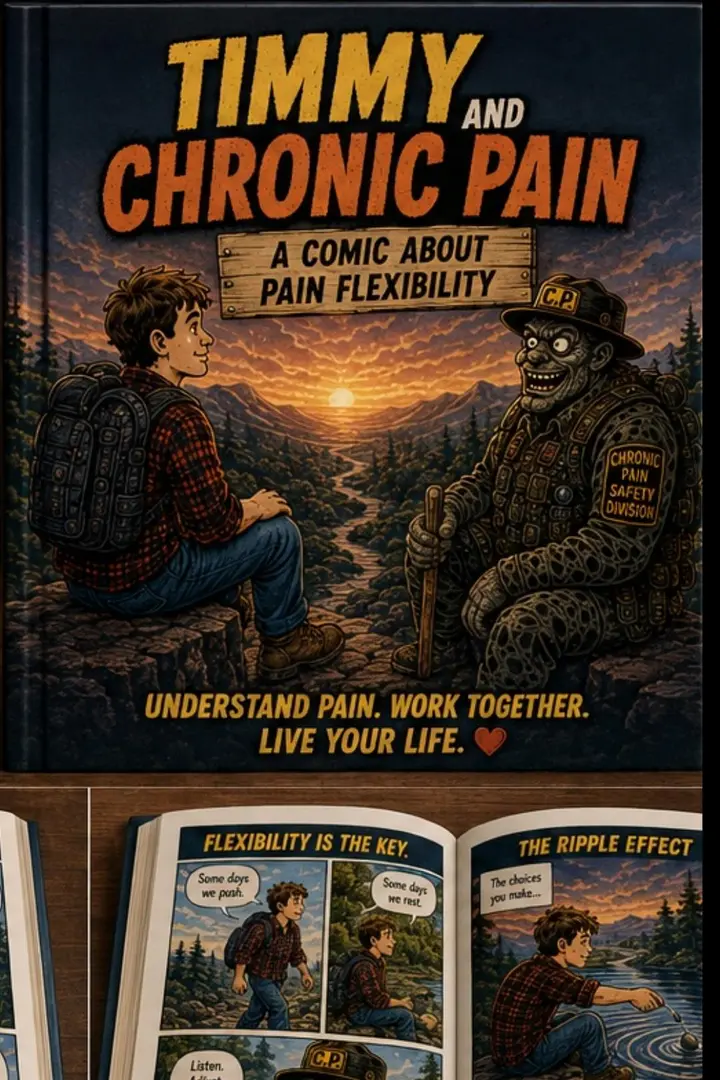
Timmy and C.P. turn pain education into an illustrated trail story about protection, courage, teamwork, and choice. The comic makes room for something important: pain can stay part of the story without writing the ending.

“Understand pain. Work together. Live your life.”
Explore the workbook
Cover of Timmy and Chronic Pain: A Comic About Pain Flexibility.
Comic cover · open full size ↗
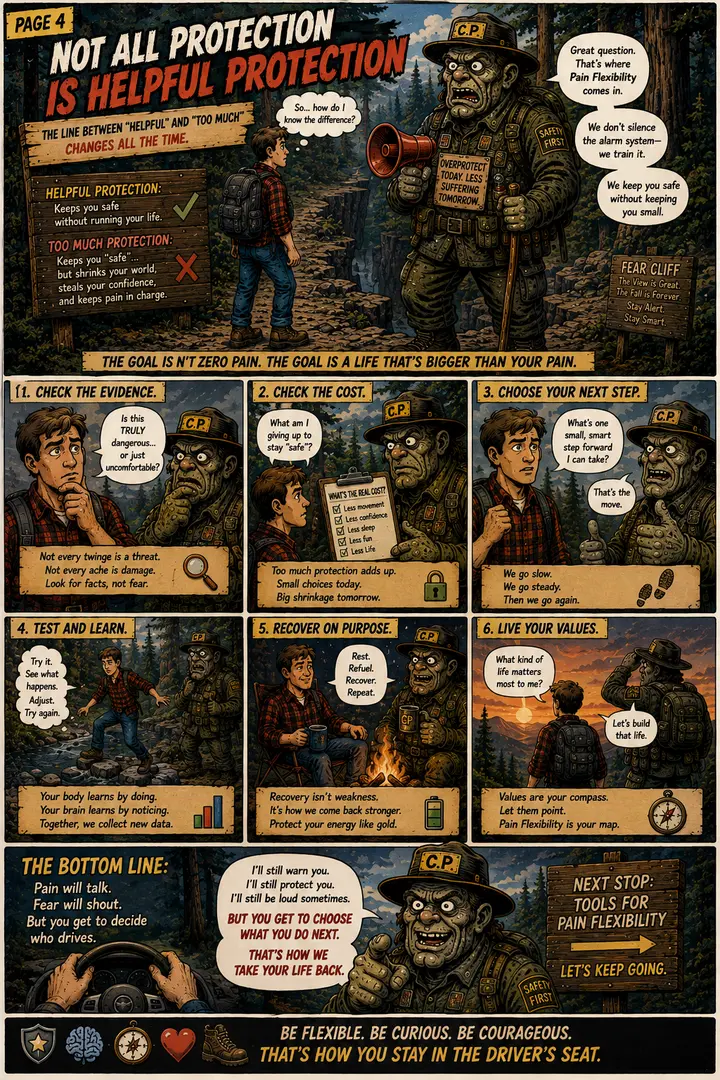
Comic page contrasting helpful protection with protection that shrinks a person’s world.
Helpful protection · open full size ↗
Comic page showing a Pain Flexibility toolkit and a commitment to meaningful living.
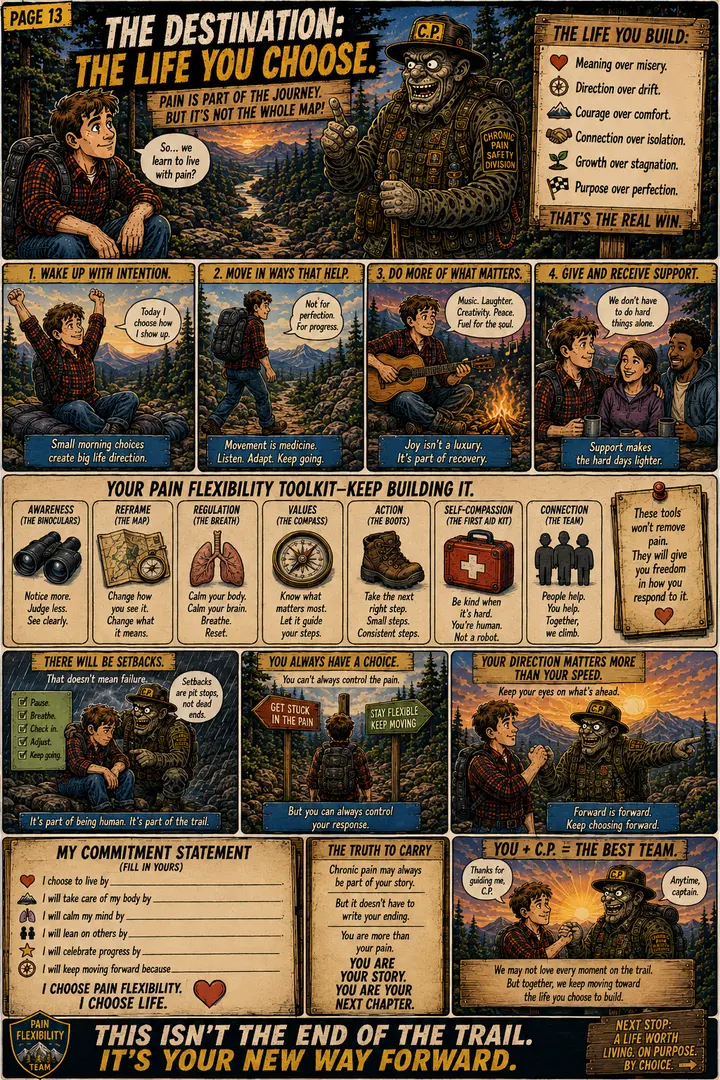
The life you choose · open full size ↗
Read comic page text: Helpful protection — comic page text

Page 4: Not all protection is helpful protection

THE LINE BETWEEN “HELPFUL” AND “TOO MUCH” CHANGES ALL THE TIME.

Sign: HELPFUL PROTECTION: Keeps you safe without running your life. TOO MUCH PROTECTION: Keeps you “safe”… but shrinks your world, steals your confidence, and keeps pain in charge.

Timmy: “So… how do I know the difference?”

C.P.: “Great question. That’s where Pain Flexibility comes in.” “We don’t silence the alarm system—we train it.” “We keep you safe without keeping you small.”

C.P.’s labels: “C.P.” “SAFETY FIRST.” “OVERPROTECT TODAY. LESS SUFFERING TOMORROW.”

Trail sign: FEAR CLIFF. The View is Great. The Fall is Forever. Stay Alert. Stay Smart.

THE GOAL ISN’T ZERO PAIN. THE GOAL IS A LIFE THAT’S BIGGER THAN YOUR PAIN.

1. Check the evidence

Timmy: “Is this TRULY dangerous… or just uncomfortable?”

Not every twinge is a threat. Not every ache is damage. Look for facts, not fear.

2. Check the cost

Timmy: “What am I giving up to stay ‘safe’?”

Checklist: WHAT’S THE REAL COST? Less movement. Less confidence. Less sleep. Less fun. Less life.

Too much protection adds up. Small choices today. Big shrinkage tomorrow.

3. Choose your next step

Timmy: “What’s one small, smart step forward I can take?”

C.P.: “That’s the move.”

We go slow. We go steady. Then we go again.

4. Test and learn

“Try it. See what happens. Adjust. Try again.”

Your body learns by doing. Your brain learns by noticing. Together, we collect new data.

5. Recover on purpose

“Rest. Refuel. Recover. Repeat.”

Recovery isn’t weakness. It’s how we come back stronger. Protect your energy like gold.

6. Live your values

Timmy: “What kind of life matters most to me?”

C.P.: “Let’s build that life.”

Values are your compass. Let them point. Pain Flexibility is your map.

The bottom line

Pain will talk. Fear will shout. But you get to decide who drives.

C.P.: “I’ll still warn you. I’ll still protect you. I’ll still be loud sometimes. BUT YOU GET TO CHOOSE WHAT YOU DO NEXT. THAT’S HOW WE TAKE YOUR LIFE BACK.”

NEXT STOP: TOOLS FOR PAIN FLEXIBILITY. LET’S KEEP GOING.

BE FLEXIBLE. BE CURIOUS. BE COURAGEOUS. THAT’S HOW YOU STAY IN THE DRIVER’S SEAT.

Read comic page text: The life you choose — comic page text

Page 13: The destination: the life you choose

PAIN IS PART OF THE JOURNEY—BUT IT’S NOT THE WHOLE MAP!

Timmy: “So… we learn to live with pain?”

C.P.’s labels: “C.P.” “CHRONIC PAIN SAFETY DIVISION.”

THE LIFE YOU BUILD: Meaning over misery. Direction over drift. Courage over comfort. Connection over isolation. Growth over stagnation. Purpose over perfection. THAT’S THE REAL WIN.

1. Wake up with intention

“Today I choose how I show up.”

Small morning choices create big life direction.

2. Move in ways that help

“Not for perfection. For progress.”

Movement is medicine. Listen. Adapt. Keep going.

3. Do more of what matters

“Music. Laughter. Creativity. Peace. Fuel for the soul.”

Joy isn’t a luxury. It’s part of recovery.

4. Give and receive support

“We don’t have to do hard things alone.”

Support makes the hard days lighter.

Your Pain Flexibility toolkit—keep building it

AWARENESS (THE BINOCULARS): Notice more. Judge less. See clearly.

REFRAME (THE MAP): Change how you see it. Change what it means.

REGULATION (THE BREATH): Calm your body. Calm your brain. Breathe. Reset.

VALUES (THE COMPASS): Know what matters most. Let it guide your steps.

ACTION (THE BOOTS): Take the next right step. Small steps. Consistent steps.

SELF-COMPASSION (THE FIRST AID KIT): Be kind when it’s hard. You’re human. Not a robot.

CONNECTION (THE TEAM): People help. You help. Together, we climb.

“These tools won’t remove pain. They will give you freedom in how you respond to it.”

There will be setbacks

That doesn’t mean failure.

Checklist: Pause. Breathe. Check in. Adjust. Keep going.

“Setbacks are pit stops, not dead ends.”

It’s part of being human. It’s part of the trail.

You always have a choice

You can’t always control the pain.

Signs: GET STUCK IN THE PAIN. STAY FLEXIBLE. KEEP MOVING.

But you can always control your response.

Your direction matters more than your speed

Keep your eyes on what’s ahead.

Forward is forward. Keep choosing forward.

My commitment statement (fill in yours)

I choose to live by __________.

I will take care of my body by __________.

I will calm my mind by __________.

I will lean on others by __________.

I will celebrate progress by __________.

I will keep moving forward because __________.

I CHOOSE PAIN FLEXIBILITY. I CHOOSE LIFE.

The truth to carry

Chronic pain may always be part of your story. But it doesn’t have to write your ending. You are more than your pain. YOU ARE YOUR STORY. YOU ARE YOUR NEXT CHAPTER.

You + C.P. = the best team

Timmy: “Thanks for guiding me, C.P.”

C.P.: “Anytime, captain.”

We may not love every moment on the trail. But together, we’re moving toward the life you choose to build.

Logo: PAIN FLEX TEAM.

THIS ISN’T THE END OF THE TRAIL. IT’S YOUR NEW WAY FORWARD.

NEXT STOP: A LIFE WORTH LIVING. ON PURPOSE. BY CHOICE.
Pain Flexibility mountain, path, and sunrise symbol
Coming soon

Companion merchandise

A small collection carrying the same practice reminders and trail-inspired visual identity. Exact products, artwork, variants, and pricing will appear here once finalized.

Live More. Suffer Less.

About Pain Flexibility

Practical education. Compassionate language. More room to live.

Pain Flexibility was created to make evidence-informed chronic pain education more understandable and usable in everyday life. The approach brings together pain education, pacing, gradual activity, nervous-system regulation, cognitive and behavioral strategies, values-based action, and social support.

Frequently asked questions

What flexibility does—and does not—mean

Who is Pain Flexibility for?

It is designed for adults living with persistent or recurring pain who want understandable education and practical self-management skills. Clinicians, caregivers, and family members may also find the framework useful.

Does flexibility mean ignoring pain or pushing through it?

No. Flexibility means responding thoughtfully instead of following one rigid rule. Depending on the situation, that may involve rest, pacing, medical attention, gradual movement, emotional regulation, or adjusting an activity.

Are you saying chronic pain is psychological?

No. Pain is real. Biological, psychological, behavioral, and social influences can all shape a pain experience, and discussing them does not mean pain is imagined or “all in your head.”

Will the workbook eliminate pain?

No specific result can be guaranteed. The aim is to help readers understand pain, build coping skills, participate more fully in life, and respond more flexibly when challenges arise.

Can I use the workbook during treatment?

Yes. You may find it helpful to discuss exercises with a physician, psychologist, physical therapist, occupational therapist, or another qualified professional who understands your circumstances.

What if an exercise increases my symptoms?

Stop or modify the activity and consult an appropriate healthcare professional when needed. New, severe, rapidly worsening, or otherwise concerning symptoms should receive prompt medical evaluation.

Your next small step

You do not have to master every skill at once.

Small, repeated changes can create more room for movement, meaning, connection, and choice.

Live More. Suffer Less.